ECONOMIC CORRIDORS (EC)
Economic Corridors (EC) in IMT-GT are strategic routes designed to enhance regional integration and economic development by improving connectivity and facilitating trade and investment. These corridors connect economic nodes, linking key growth centres, ports, SEZ and border crossings, creating a network that supports the movement of goods, services, and people across the subregion.
The economic corridor (EC) approach to development was first emphasised in the IMT-GT Road Map 2007–2011 as a key anchor for clustering major economic activities in the subregion. The IMT-GT Implementation Blueprint 2012–2016 (IB 2012–2016)—the successor to the road map—included economic corridor development programs and projects among the flagship initiatives in the transport and energy sector. The importance of economic corridors was carried over to the IB 2017–2021 and the consecutive IB 2022-2026, which reaffirmed economic corridor development as a spatial framework to help achieve the IMT-GT 2036 Vision.
The IB 2022-2026 utilises a corridor-centric approach to development, introducing the following:
- The existing economic corridors have been reconfigured to connect more nodes, such as capital cities, commercial nodes, maritime gateway ports, and tourism nodes, to function as a network rather than as single corridors.
- The corridors aim to optimise economic complementarities, enhance multimodal connectivity, and promote cross-border value chains and special economic zones (SEZs).
Physical Connectivity Projects (PCPs) form the backbone of IMT-GT’s economic corridors, focusing on the development of roads, railways, ports, and transport links that connect markets and communities across borders.
As a cornerstone of IMT-GT’s integration agenda, PCPs enhance transport, logistics, and mobility to support economic corridor development and advance regional trade facilitation. Each project is designed to address specific connectivity gaps by road, rail, air, or sea, improving access to markets and creating new opportunities for investment and growth.
Implemented through close collaboration among national governments, subnational authorities, and development partners such as the Asian Development Bank (ADB), PCPs support a more connected and competitive subregion.
PCPs focus on:
- Expanding and upgrading road and rail networks to strengthen corridor connectivity
- Improving port and maritime infrastructure, including Ro-Ro ferry terminals and logistics hubs
- Enhancing air connectivity through bilateral and multilateral linkages
- Promoting sustainable, climate-resilient, and digitally enabled transport infrastructure
Closely coordinated with the Working Group on Transport Connectivity (WGTC), PCPs serve as key catalysts for economic integration, trade expansion, and people-to-people connectivity across the IMT-GT subregion.
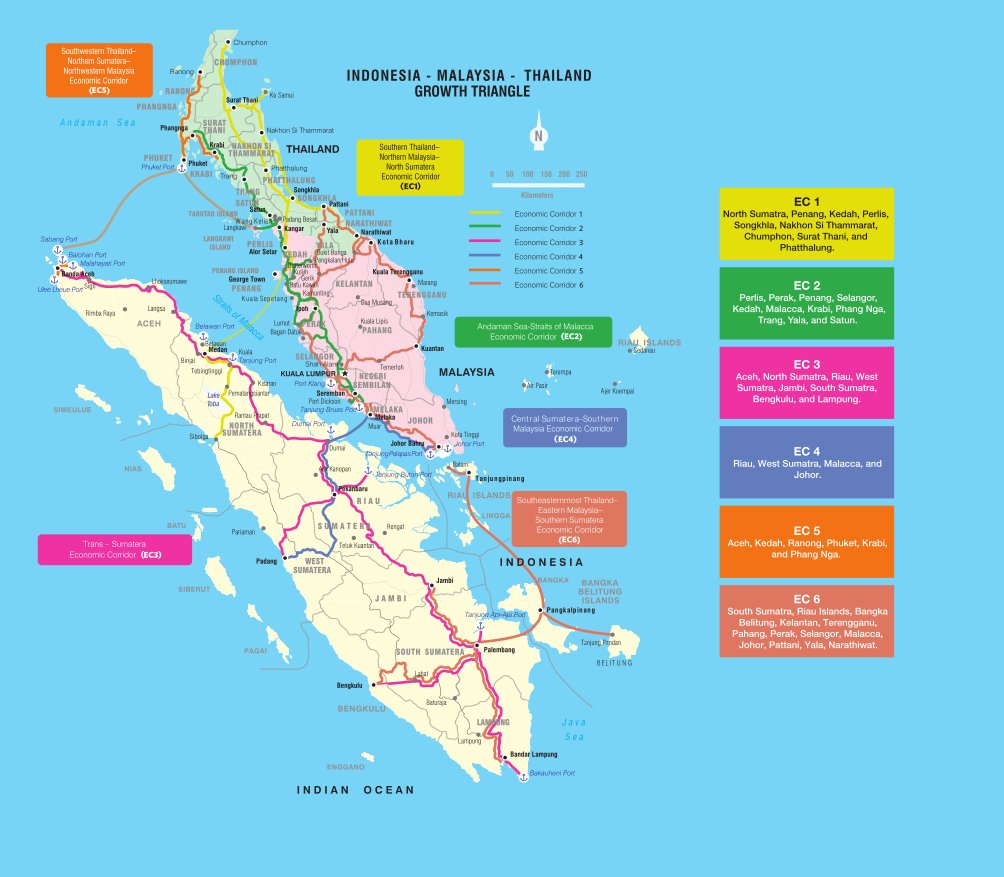
Each corridor promotes integrated development by clustering industries, improving logistics networks, and supporting border towns as emerging economic centres. The corridors are aligned with national development priorities and the ASEAN Connectivity Master Plan, helping IMT-GT bridge markets, communities, and opportunities.
Economic corridors offer numerous benefits, including enhanced connectivity through improved transport links, which facilitate the efficient movement of goods and people. They drive economic growth by increasing trade and investment opportunities and fostering regional development. Additionally, they strengthen regional integration by promoting economic ties among member countries, contributing to stability and cooperation. With a focus on green, blue, and circular economy models, economic corridors also support sustainable and inclusive growth. As a cornerstone of the IMT-GT’s strategy, these corridors align with the vision of creating an integrated, innovative, inclusive, and sustainable subregion by 2036.
Centre for IMT-GT Subregional Cooperation (CIMT)
Office 3A, Level 3, Block C, Menara PjH, Precinct 2, 62100, Putrajaya, Malaysia

Indonesia
Coordinating Ministry for Economic Affairs (CMEA)
Malaysia
Ministry of Economy
Thailand
Office of the National Economic and Social Development Council (NESDC)