IMPLEMENTATION BLUEPRINT 2017-2021
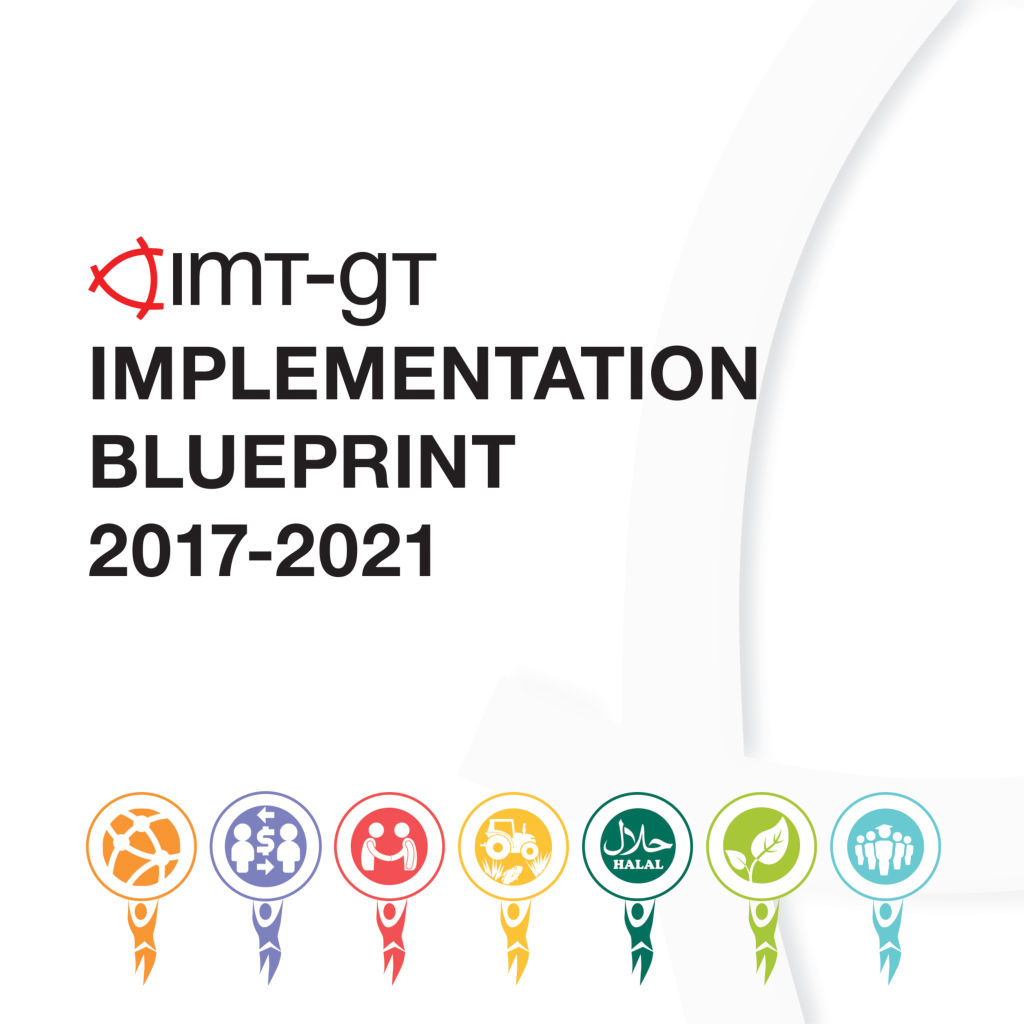
Laying the Foundation for Vision 2036
The Implementation Blueprint I (IB 2017-2021) marked the first batch of five-year strategies of IMT-GT’s journey towards achieving Vision 2036. It provided the initial roadmap to guide the subregion’s efforts in building an integrated, innovative, inclusive, and sustainable economic community.
IB 2017–2021 focused on delivering measurable progress through seven key priority objectives:
- Real GDP increases to US$ 299 billion from US$ 215 billion in 2014
- GDP per capita increases to US$ 16,974 (2015: US$ 13,844)
- Intra-IMT-GT trade increases to 11.5 percent of total IMT trade (2015: 9.2 percent)
- Average annual FDI inflows to IMT-GT increase to US$11 billion (2011-2015: US$8 billion per annum (5-year average))
- Average annual international visitor arrivals increase to 52 million persons (2015: 39 million)
- IMT-GT Project Implementation Team and JBC implement a total of 100 cross-border projects with direct MSMEs and social enterprises’ participation (i.e., 20 projects per year)
- At least 10 cities in IMT-GT implement the Green City Action Plan (2016: 5 cities)
Consistent with Vision 2036, IB 2017-2021 emphasises on the need to identify and implement catalytic projects that are scalable, replicable and sustainable in order to propel IMT-GT to a deeper level of economic integration. To accelerate project implementation, IB 2017-2021 underlines the importance of instituting project-level and location specific regulatory reforms.
IB 2017-2021 resolves to maximise the economic network externalities of the five priority economic corridors through improving physical connectivity, addressing software deficits, infusion of innovation and creation of cross-border value chains. It underscores the importance of applying a spatial approach to better conserve the natural environment.
IB 2017-2021 places the private sector and local governments at the heart of its efforts to accelerate subregional economic and social development.
To achieve its goals, IB 2017–2021 was supported by seven strategic pillars:
- Agriculture and Agro-based Industry
- Tourism
- Halal Products and Services
- Transport and ICT Connectivity
- Trade and Investment Facilitation
- Environment
- Human Resource Development, Education, and Culture
In line with the recommendations of the Mid-term Review of IB 2012–2016, the subsequent Implementation Blueprint further mainstreamed the results-based monitoring and evaluation system outlined in the IMT-GT Project Manual.
IB 2017–2021 laid the groundwork for deeper cooperation by aligning strategies with ASEAN and the Asian Development Bank (ADB), while promoting new partnerships across sectors. It provided a solid institutional and strategic foundation for the subsequent phase, Implementation Blueprint II (2022–2026), which accelerated integration, innovation, and sustainable growth across the IMT-GT subregion.
Leader's Summit
The IMT-GT Leaders’ Summit is the highest decision-making body of the subregion. It provides strategic policy direction, fosters consensus on key economic and social development priorities, and guides subregional cooperation and integration among member countries. The Summit also reinforces political commitment at the highest level, ensuring that IMT-GT remains aligned with regional and global development agendas. Its outcomes set the vision and long-term trajectory for the subregion’s collective progress.
Ministerial Meeting
The Ministerial Meeting (MM) provides overall guidance on IMT-GT’s strategic blueprints. It sets policy directions, addresses emerging challenges, and serves as a platform for ministers to exchange views and strengthen cross-sectoral coordination. The MM translates the vision of the Leaders’ Summit into actionable strategies, ensuring coherence across national policies. It also provides a venue for ministers to reaffirm their commitment to advancing IMT-GT’s shared goals.
CHIEF MINISTERS AND GOVERNORS’ FORUM
The Chief Ministers and Governors’ Forum (CMGF) bridges national and local priorities by aligning subregional initiatives with provincial and state-level development plans. It raises awareness of IMT-GT opportunities and facilitates bottom-up projects that deliver direct benefits to communities. The Forum empowers local leaders to take ownership of IMT-GT initiatives, ensuring that development is inclusive and responsive to grassroots needs. It also strengthens people-to-people connectivity by linking communities across borders.
SENIOR OFFICIALS’ MEETING
The Senior Officials’ Meeting (SOM) serves as the central mechanism for coordination and policy alignment within IMT-GT. It determines implementation priorities, monitors progress, harmonises policies, and ensures the effective implementation of IMT-GT programmes and projects. The SOM plays a pivotal role in translating ministerial guidance into operational plans. It also oversees the effectiveness of measures and strategies, fosters cross-sectoral collaboration to address emerging challenges, and encourages shared responsibilities across IMT-GT bodies.
NATIONAL SECRETARIATS
Each Member Country maintains a National Secretariat (NS) to coordinate and monitor IMT-GT initiatives at the national level. Serving as the national focal point, the NS integrates IMT-GT programmes into national development agendas and ensures adequate policy and resource support from national government. It also strengthens institutional linkages, fostering closer collaboration among agencies and stakeholders. In addition, the NS plays a vital role in supporting integrative planning, providing cross-sectoral solutions, and ensuring robust coordination and collaboration between national governments and subnational governments, as well as between central agencies and line agencies.
WORKING GROUPS
The Working Groups (WGs) serve as the implementation arms of IMT-GT. Each WG focuses on a specific strategic pillar, translating policies into actionable projects that strengthen cooperation and deliver tangible results across the subregion. They provide technical expertise, develop sectoral strategies, and ensure that initiatives are aligned with both national priorities and IMT-GT’s overarching vision. By fostering collaboration among member countries and engaging with stakeholders, the WGs play a vital role in driving progress and ensuring that IMT-GT commitments deliver concrete results across the subregion. Convergence meetings between the Working Groups can be held to enhance cross-sectoral collaboration and align strategies to accelerate project implementation. Some WGs require specialised technical expertise to effectively carry out their mandates. To facilitate the implementation of projects, smaller technical entities may be established to provide focused support. These entities (commonly referred to as Sub-Working Group, Project Implementation Team, or Task Forces) serve as dedicated mechanisms to address specific technical, operational, or cross-sectoral needs. By complementing the broader work of the WGs, they help ensure that projects are implemented with precision, timeliness, and practical solutions tailored to complex challenges.
CENTRE FOR IMT-GT SUBREGIONAL COOPERATION
The Centre for IMT-GT Subregional Cooperation (CIMT) serves as the central secretariat for the IMT-GT framework. Its role is to initiate, advise, coordinate, facilitate, implement, monitor, and evaluate IMT-GT programmes, projects, and activities, ensuring they are effectively delivered and aligned with the subregion’s strategic priorities. The Centre also plays a catalytic role in accomplishing IMT-GT goals through facilitating, coordinating, monitoring, and evaluating the implementation of programmes, projects, and activities. Some WGs require specialised technical expertise to effectively carry out their mandates. To facilitate the implementation of projects, smaller technical entities may be established to provide focused support. These entities (commonly referred to as Sub-Working Group, Project Implementation Team, or Task Forces) serve as dedicated mechanisms to address specific technical, operational, or cross-sectoral needs. By complementing the broader work of the WGs, they help ensure that projects are implemented with precision, timeliness, and practical solutions tailored to complex challenges.
JOINT BUSINESS COUNCIL (JBC)
The Joint Business Council (JBC) represents the private sector within IMT-GT, promoting trade and investment while channelling business perspectives into policy discussions. Through strong public–private collaboration, it supports the implementation of IMT-GT projects and helps align them with market opportunities. The JBC also plays a vital role in fostering entrepreneurship, enhancing competitiveness, and building networks that connect businesses across borders, thereby driving inclusive economic growth in the subregion. Some WGs require specialised technical expertise to effectively carry out their mandates. To facilitate the implementation of projects, smaller technical entities may be established to provide focused support. These entities (commonly referred to as Sub-Working Group, Project Implementation Team, or Task Forces) serve as dedicated mechanisms to address specific technical, operational, or cross-sectoral needs. By complementing the broader work of the WGs, they help ensure that projects are implemented with precision, timeliness, and practical solutions tailored to complex challenges.
UNIVERSITY NETWORK (UNINET)
The IMT-GT University Network (UNINET) connects higher education institutions across the subregion. Established in 1996, UNINET initially comprised eight universities in the network. The signing of the UNINET Charter in 2017 had further institutionalized UNINET as a subregional body and formalised its cooperation agenda. To date, 32 public universities are members of UNINET. It promotes research collaboration, academic exchange, and innovation, recognising the critical role of education in driving economic and social progress. Some WGs require specialised technical expertise to effectively carry out their mandates. To facilitate the implementation of projects, smaller technical entities may be established to provide focused support. These entities (commonly referred to as Sub-Working Group, Project Implementation Team, or Task Forces) serve as dedicated mechanisms to address specific technical, operational, or cross-sectoral needs. By complementing the broader work of the WGs, they help ensure that projects are implemented with precision, timeliness, and practical solutions tailored to complex challenges.
ASIAN DEVELOPMENT BANK (ADB)
ADB has been involved in the IMT-GT initiative since its inception, and has been a Development Partner since 2007. ADB’s support to IMT-GT covers a wide range of technical assistance. It has been playing a key role as an adviser on policy and technical matters, a trusted facilitator in fostering partnership, and a mobiliser of funding. ADB supports the implementation of IMT-GT strategic initiatives, in close collaboration with the working groups, national secretariats, the CIMT and other subregional mechanisms and strengthens partnership building and resource mobilisation. Some WGs require specialised technical expertise to effectively carry out their mandates. To facilitate the implementation of projects, smaller technical entities may be established to provide focused support. These entities (commonly referred to as Sub-Working Group, Project Implementation Team, or Task Forces) serve as dedicated mechanisms to address specific technical, operational, or cross-sectoral needs. By complementing the broader work of the WGs, they help ensure that projects are implemented with precision, timeliness, and practical solutions tailored to complex challenges.
ACHIEVEMENTS
Real GDP expanded from USD 215 billion (2014) to USD 299 billion by 2021.
GDP per capita increased from USD 13,844 (2015) to USD 16,974 by 2021.
Intra-IMT-GT trade grew from 9.2% (2015) to 11.5% of total IMT trade by 2021, reflecting stronger cross-border integration.
Average annual foreign direct investment (FDI) inflows rose from USD 8 billion (2011–2015 average) to USD 11 billion by 2021.
Average annual international visitor arrivals increased from 39 million (2015) to 52 million by 2021.
A total of 100 cross-border projects were implemented by the Project Implementation Team (PIT) and Joint Business Council (JBC), with direct participation of micro, small, and medium-sized enterprises (MSMEs) and social enterprises during 2017–2021.
At least 10 cities across the IMT-GT subregion successfully implemented Green City Action Plans (GCAP) by 2021.
Centre for IMT-GT Subregional Cooperation (CIMT)
Office 3A, Level 3, Block C, Menara PjH, Precinct 2, 62100, Putrajaya, Malaysia

Indonesia
Coordinating Ministry for Economic Affairs (CMEA)
Malaysia
Ministry of Economy
Thailand
Office of the National Economic and Social Development Council (NESDC)