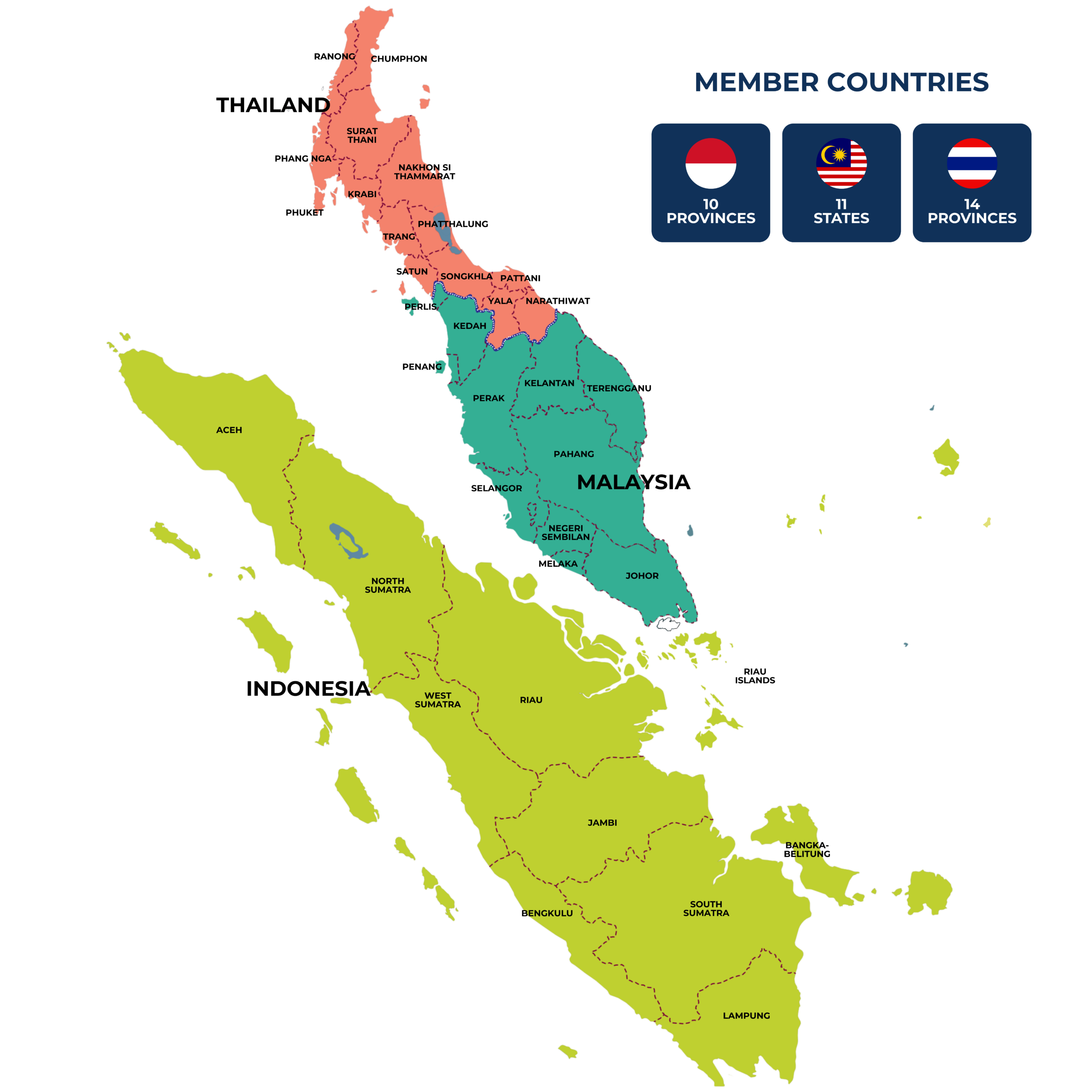
What began in 1993 as a bold idea to connect neighbouring regions across Indonesia, Malaysia, and Thailand has grown into one of Southeast Asia’s most enduring subregional cooperation platforms. Starting with just 12 states and provinces, the Indonesia–Malaysia–Thailand Growth Triangle (IMT-GT) was founded on a simple but powerful belief: that shared geography and cooperation could unlock shared prosperity.
Early momentum followed quickly. With the Asian Development Bank coming on board in 1994, IMT-GT strengthened its foundations through the creation of key institutions, including the Joint Business Council to amplify private sector voices and the University Network to harness knowledge, research, and talent across borders.
As cooperation deepened, IMT-GT moved from vision to action. Landmark moments such as the first IMT-GT Summit in 2005 and the launch of the Chief Ministers’ and Governors’ Forum brought political leadership and subnational governments to the forefront. The introduction of Economic Corridors in 2007 marked a shift towards spatial, corridor-based development that connected cities, ports, and communities across the subregion.
Over the next decade, IMT-GT evolved with the times. Sustainability, green growth, and long-term planning took centre stage through successive Implementation Blueprints, the establishment of CIMT as a permanent secretariat, and the adoption of Vision 2036, setting a clear course towards inclusive, innovative, and sustainable development.
Today, with 35 states and provinces and over 30 years of cooperation, IMT-GT continues to adapt and grow. From expanding air connectivity and geopark cooperation to strengthening trade facilitation through the CIQ Framework, IMT-GT remains a living partnership—connecting borders, empowering communities, and shaping the future of subregional cooperation.